Explore expanded metal patterns, including diamond, micro, raised, flattened and decorative designs. Compare SWD, LWD, materials, sizes and applications.
What Are Expanded Metal Patterns?
Expanded metal patterns are the geometric opening designs created when a metal sheet is slit and stretched through an expanding process. The most recognizable pattern is the diamond shape, but specialized manufacturing methods can also produce different decorative and non-standard opening configurations.
Expanded metal is manufactured from a continuous metal sheet rather than separate wires. Unlike welded wire mesh, its interconnected strands and bonds are formed directly from the original material without welding individual wire intersections.
The pattern influences several important product characteristics, including:
Opening dimensions and geometry.
Percentage of open area.
Airflow and light transmission.
Visibility and visual screening.
Panel weight and rigidity.
Fabrication and installation requirements.
Architectural appearance.
Manufacturing and purchasing costs.
Expanded metal patterns are widely used in architectural facades, industrial machinery guards, construction lath, fencing, protective screens, ventilation grilles, and selected heavy-duty grating systems.
For international buyers, choosing the correct expanded metal pattern requires understanding more than the shape of the openings. Material grade, strand width, sheet thickness, pattern orientation, surface profile, and supporting structure should also be considered.
ANPING METAL MESH provides expanded metal product information and supports project-based specification enquiries for construction, industrial, and architectural applications.
Buyers can explore different products through our Expanded Metal Product Center.
How Are Expanded Metal Patterns Manufactured?
Expanded metal patterns are formed through a mechanical process that simultaneously slits and stretches a solid metal sheet.
The process creates interconnected openings without removing the same amount of material associated with conventional hole punching.
1. Base Metal Selection
Manufacturing begins with selecting the appropriate metal sheet.
Common materials include:
Carbon steel.
Galvanized steel.
Aluminum alloys.
Stainless steel 304.
Stainless steel 316.
Material selection affects mechanical properties, corrosion resistance, weight, appearance, and manufacturing feasibility.
2. Slitting and Expanding
The metal sheet passes through specialized expanding equipment.
The machine creates staggered cuts while stretching the material to form interconnected openings.
The resulting pattern depends on the tooling, machine settings, material characteristics, and required dimensions.
3. Raised Pattern Formation
The expanding process commonly produces a raised mesh structure.
The strands and connecting bonds are positioned at angles relative to the original sheet plane.
This creates a textured, three-dimensional surface.
4. Flattening Process
Some expanded metal products are passed through additional rolling equipment.
This process creates a flatter surface profile.
Flattening can change the finished thickness and strand geometry, so raised and flattened products should not automatically be treated as dimensionally identical.
5. Cutting and Finishing
Expanded metal can be cut into sheets or fabricated into panels.
Depending on the material and project requirements, additional processing may include:
Edge trimming.
Bending and forming.
Frame fabrication.
Galvanizing.
Powder coating.
Anodizing for suitable aluminum alloys.
Other appropriate surface treatments.
Main Types of Expanded Metal Patterns
Expanded metal products can be classified by opening geometry, opening size, and surface structure.
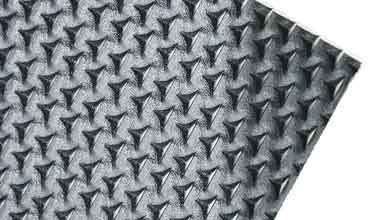
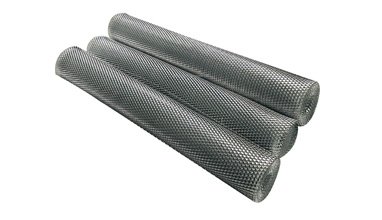
The standard diamond is the most familiar pattern. Other designs may involve smaller diamonds, larger industrial patterns, modified diamond proportions, or custom decorative geometry.
Raised and flattened expanded metal describe different surface profiles rather than entirely different opening shapes.
Expanded Metal Pattern Comparison Table
| Pattern Type | Opening Characteristics | Main Applications |
|---|---|---|
| Standard Diamond | Conventional interconnected diamond openings | Fencing, guards, construction |
| Micro Diamond | Small diamond openings | Ventilation, screens, filter supports |
| Raised Diamond | Three-dimensional diamond structure | Industrial guards, selected grating |
| Flattened Diamond | Rolled, relatively flat diamond structure | Decorative panels, partitions |
| Heavy-Duty Diamond | Industrial patterns with suitable strand dimensions | Platforms, equipment protection |
| Modified Diamond | Different diamond proportions or orientations | Architecture, screening |
| Custom Decorative | Project-specific opening geometry | Facades, interiors, art panels |
Note: Square, rectangular, and hexagonal-looking designs may be available through specialized manufacturing processes. They should not be assumed to be standard expanded metal patterns or universally available from every supplier.
Actual availability depends on tooling, material, sheet dimensions, and manufacturing feasibility.
1. Standard Diamond Expanded Metal Patterns
The standard diamond is the most widely recognized expanded metal pattern.
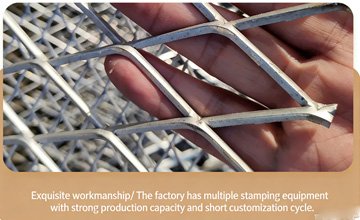
It consists of interconnected metal strands arranged into regular diamond-shaped openings.
This pattern is produced through the slitting and stretching process and can be manufactured in different materials, thicknesses, and dimensions.
Main Characteristics
Continuous metal construction.
Regular diamond-shaped openings.
Various SWD and LWD dimensions.
Different strand widths.
Raised or flattened surface options.
Suitable for a wide range of fabrication methods.
Typical Applications
Standard diamond expanded metal is commonly used for:
Industrial fencing.
Machinery guards.
Protective equipment covers.
Warehouse partitions.
Decorative metal panels.
Construction-related products.
General metal fabrication.
The diamond opening allows air and light to pass through the mesh.
However, the actual airflow, visibility, and mechanical performance depend on the opening geometry and other technical specifications.
Available Material Options
Standard diamond patterns can be produced in suitable carbon steel, aluminum, and stainless steel materials.
Galvanized steel products may also be considered where corrosion protection is required.
For additional technical information, see our Diamond Expanded Metal Mesh Sizes guide.
2. Micro Diamond Expanded Metal Patterns
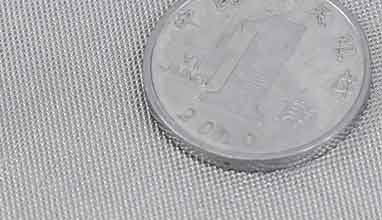
Micro diamond expanded metal features relatively small openings and fine metal strands.
These patterns can be used in applications requiring compact opening geometry and a more detailed mesh appearance.
Main Characteristics
Small diamond-shaped openings.
Fine mesh appearance.
Different metal thicknesses.
Relatively compact patterns.
Suitable for selected precision fabrication requirements.
Common Applications
Micro expanded metal may be used for:
Equipment ventilation grilles.
Speaker covers.
Electronic equipment protection.
Decorative screening.
Filter support layers.
Industrial protective screens.
Architectural details.
Is Micro Expanded Metal Suitable for Filtration?
Micro expanded metal can be incorporated into certain filtration assemblies.
However, the opening size alone does not establish filtration performance.
For applications requiring precise particle retention, buyers should confirm the actual clear opening, material compatibility, operating conditions, and complete filter design.
In many systems, expanded metal acts as a supporting or protective layer rather than the primary fine filtration medium.
3. Raised Expanded Metal Patterns
Raised expanded metal, also called standard or unflattened expanded metal, retains the three-dimensional profile formed during the expanding process.
The metal strands are angled relative to the original sheet plane, producing a textured surface.
Main Characteristics
Three-dimensional mesh structure.
Raised strands and bonds.
Textured appearance.
Different opening dimensions.
Suitable for selected industrial applications.
Typical Applications
Raised expanded metal may be used in:
Industrial machinery guards.
Equipment enclosures.
Protective screens.
Certain walkway and grating systems.
Industrial fabrication.
Suitable anti-slip surfaces.
Raised Expanded Metal for Walkways
Some raised expanded metal grating products are manufactured for industrial walking surfaces.
The raised surface may offer useful traction characteristics in appropriate applications.
However, raised expanded metal should not automatically be described as suitable for heavy pedestrian or vehicle traffic.
Load-bearing applications require verification of material grade, strand dimensions, support spacing, expected loads, and relevant engineering standards.
4. Flattened Expanded Metal Patterns
Flattened expanded metal is manufactured by passing raised expanded metal through a cold rolling or leveling process.
The resulting mesh has a flatter profile and may provide a different visual and handling experience from raised expanded metal.
Main Characteristics
Relatively flat surface.
Consistent decorative appearance.
Diamond-shaped opening patterns.
Suitable for selected fabricated panels.
Different material and finishing options.
Typical Applications
Flattened expanded metal is commonly considered for:
Interior decorative screens.
Architectural partitions.
Ceiling panels.
Furniture components.
Decorative wall cladding.
Equipment covers.
Retail display fixtures.
Raised vs. Flattened Expanded Metal
| Feature | Raised Expanded Metal | Flattened Expanded Metal |
|---|---|---|
| Manufacturing | Slit and stretched | Expanded, then rolled |
| Surface Profile | Three-dimensional | Relatively flat |
| Appearance | Textured | More uniform and flat |
| Common Uses | Industrial guards, selected grating | Decorative panels, partitions |
| Dimensions | Based on expanded form | May change during flattening |
| Processing | Standard expanding process | Additional rolling process |
Neither type is universally stronger or more suitable for every application.
The correct choice depends on the product specifications and intended use.
Flattened edges can still be sharp after cutting, so appropriate edge treatment may be necessary.
5. Heavy-Duty Diamond Expanded Metal Patterns
Heavy-duty expanded metal uses specifications selected for industrial applications that may require greater mechanical capacity.
These products often involve thicker original sheets and wider metal strands.
However, a large diamond opening alone does not make a product heavy-duty.
Main Characteristics
Industrial material thickness options.
Suitable strand widths.
Different opening dimensions.
Raised and other available configurations.
Can be incorporated into engineered structures.
Typical Applications
Heavy-duty expanded metal may be used in:
Industrial platforms.
Machinery protection.
Equipment access structures.
Stair treads.
Industrial enclosures.
Protective barriers.
Selected grating systems.
Important Engineering Considerations
For any load-bearing application, buyers should confirm:
Material grade.
Strand width.
Original sheet thickness.
Diamond opening dimensions.
Support spacing.
Load requirements.
Deflection limitations.
Installation details.
The finished product must be evaluated as part of the complete supporting structure.
A pattern should not be classified as suitable for industrial flooring solely because it has thick strands or large diamond openings.
6. Custom Decorative Expanded Metal Patterns
Custom decorative expanded metal patterns are used in architectural and design projects requiring distinctive geometric appearances.
These designs may involve modified diamond proportions, specialized opening configurations, or combinations of different panel orientations.
Certain specialized production methods can also create square-like, hexagonal-like, or other decorative designs.
However, these patterns are not automatically available with conventional expanded metal tooling.
Common Applications
Custom decorative patterns may be considered for:
Commercial building facades.
Architectural sunshades.
Interior feature walls.
Decorative ceiling systems.
Exhibition displays.
Public architectural installations.
Retail interiors.
Branded architectural elements.
Custom Pattern Requirements
Architects and procurement managers should provide detailed information, including:
Required visual pattern.
Opening dimensions.
Metal grade.
Panel size.
Strand dimensions.
Surface finish.
Pattern orientation.
Fabrication tolerances.
Technical drawings and physical samples may be useful when evaluating manufacturing feasibility.
Can Expanded Metal Produce Square or Hexagonal Patterns?
Some specialized mesh designs can create square-like, rectangular, or hexagonal visual effects.
However, conventional expanded metal manufacturing predominantly produces diamond-shaped openings.
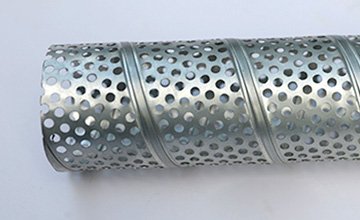
If a project requires precise square or hexagonal openings, buyers should also compare perforated metal and other mesh manufacturing methods.
The required geometry should be confirmed through drawings before selecting a manufacturing process.
Understanding Expanded Metal Pattern Dimensions
The main technical dimensions determine how an expanded metal pattern is described and manufactured.
Incorrect interpretation of these measurements can result in products that do not match the intended application.
SWD – Short Way of Diamond
SWD describes the short-way dimension of the expanded metal design.
It is commonly measured across the short direction of the repeating pattern, using the relevant bond-to-bond measurement convention.
SWD should not automatically be interpreted as the clear opening width.
LWD – Long Way of Diamond
LWD describes the long-way dimension of the expanded metal design.
Together, SWD and LWD identify the primary dimensions of the repeating diamond pattern.
SWO – Short Way of Opening
SWO refers to the short-way clear opening dimension.
It is used when the actual available space within the diamond opening matters.
LWO – Long Way of Opening
LWO refers to the long-way clear opening dimension.
It is particularly useful for applications where passage through the opening must be considered.
Strand Width
Strand width is the width of the metal strips forming the interconnected pattern.
It influences material content, appearance, open area, and mechanical characteristics.
Strand Thickness
Strand thickness commonly refers to the base metal thickness associated with the expanded mesh.
The overall finished thickness can differ, particularly for raised expanded metal.
Bond
A bond is the solid connection where expanded metal strands meet.
Bonds are formed from the original continuous sheet material rather than by welding separate wires together.
Open Area
Open area is the proportion of the mesh surface occupied by openings.
It is commonly expressed as a percentage.
Open area affects visibility, light transmission, and potential airflow.
However, open area alone does not determine the ventilation performance or filtration characteristics of the completed system.
Expanded Metal Pattern Size Reference Table
The following examples illustrate different diamond pattern dimensions.
All dimensions are expressed as SWD × LWD, with the shorter dimension listed first.
| Pattern Category | Illustrative SWD × LWD | Potential Applications |
|---|---|---|
| Micro Diamond | 3 × 6 mm | Small screens, decorative details |
| Fine Diamond | 5 × 10 mm | Grilles, compact protective mesh |
| Small Diamond | 10 × 20 mm | General screening, decoration |
| Medium Diamond | 15 × 30 mm | Partitions, protective panels |
| General Industrial Diamond | 20 × 40 mm | Guards, fencing |
| Large Diamond | 40 × 80 mm | Industrial panels |
| Extra-Large Diamond | 50 × 100 mm | Specialized industrial applications |
Specification Note: These dimensions are illustrative examples based on the original article, not confirmed stock specifications or guaranteed manufacturing options.
They do not represent clear opening dimensions unless explicitly defined that way.
Actual specifications must also include strand width, material thickness, sheet dimensions, and any required tolerances.
For further dimensional information, read our Expanded Metal Dimensions Chart.
How Pattern Size Affects Expanded Metal Performance
Expanded metal pattern size affects multiple product characteristics.
However, the relationship between opening size and performance depends on the complete mesh geometry.
1. Strength and Rigidity
Mechanical performance depends on material grade, strand width, thickness, opening pattern, orientation, and support conditions.
Smaller openings do not automatically produce greater load-bearing capacity.
2. Open Area
Different diamond patterns and strand dimensions produce different open-area percentages.
A more open mesh may improve visibility and allow more air and light through the panel, depending on the complete installation.
3. Weight
Finished mesh weight depends on material density, pattern geometry, strand dimensions, and overall sheet size.
Two panels with similar diamond openings can have significantly different weights.
4. Visibility and Privacy
Expanded metal can provide visual screening.
Its effect depends on opening dimensions, panel angle, lighting, viewing direction, and distance.
A physical sample is useful when privacy or architectural appearance is important.
5. Manufacturing Cost
Different opening patterns require different manufacturing settings and material consumption.
Pricing may also be affected by production quantity, tooling requirements, and additional fabrication.
6. Installation and Fabrication
Pattern orientation can influence the way panels are framed, cut, aligned, and installed.
For architectural projects, the required direction should be shown in technical drawings.
Expanded Metal Pattern Orientation
Pattern orientation is particularly important for architectural and industrial projects.
Diamond openings have long and short directions.
Rotating the mesh changes how the pattern appears when viewed from different angles.
Horizontal Orientation
In some architectural installations, the long direction of the diamond pattern runs horizontally.
This produces a particular visual rhythm and may affect shading and viewing angles.
Vertical Orientation
When the pattern is rotated, the long direction may run vertically.
This creates a different appearance and can affect how the mesh aligns with the supporting frame.
Why Orientation Matters
For facade applications, designers should confirm:
SWD and LWD directions.
Overall panel dimensions.
Expected visual appearance.
Direction of adjacent panels.
Edge configuration.
Supporting frame layout.
The selected orientation should be clearly identified before manufacturing.
Common Materials Used for Expanded Metal Patterns
Expanded metal can be produced from different metal sheets, subject to manufacturing feasibility.
1. Carbon Steel
Carbon steel is commonly used in industrial mesh, equipment protection, fabrication, and suitable grating applications.
For outdoor installations, protective finishing may be required.
2. Galvanized Steel
Galvanized expanded metal uses a zinc protective coating to improve corrosion resistance.
Coating specifications should be selected according to the intended environment.
3. Aluminum
Aluminum expanded metal is frequently considered for architectural and decorative applications because of its relatively low weight and finishing options.
Different aluminum alloys have different mechanical and forming characteristics.
4. Stainless Steel 304
Stainless steel 304 is suitable for many applications requiring general corrosion resistance.
It may be used in industrial screens, equipment panels, and selected architectural projects.
5. Stainless Steel 316
Stainless steel 316 generally provides improved resistance to chloride-related corrosion compared with stainless steel 304.
It may be appropriate for some coastal and industrial environments.
Actual suitability depends on exposure conditions and maintenance.
Not every custom pattern can be manufactured in every material.
Expanded Metal Patterns for Different Applications
Architectural Facades
Expanded metal is used for decorative facade screens, sun-shading systems, and exterior architectural panels.
Aluminum diamond patterns and suitable custom decorative designs can create distinctive building appearances.
For facade projects, the pattern should be selected together with the supporting structure, wind load requirements, corrosion protection, and finishing specification.
For more information, read our Expanded Metal Mesh Facade Guide.
Construction and Plastering
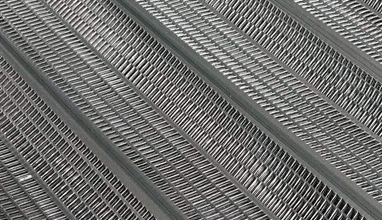
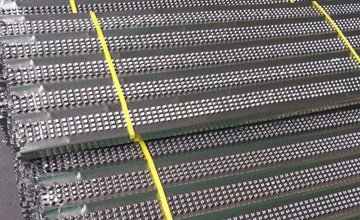
Specialized expanded metal lath is used in selected plastering and stucco systems.
These products typically use diamond-shaped structures designed for the relevant plaster application.
Expanded metal lath is different from conventional industrial expanded metal sheets.
It should not automatically be used as a substitute for specified structural concrete reinforcement.
See our Expanded Metal Lath for Stucco guide.
Industrial Machinery Guards
Expanded metal can be fabricated into suitable machinery protection panels and equipment enclosures.
The opening dimensions must be compatible with the relevant safety distances and guarding requirements.
Industrial Walkways
Appropriately designed expanded metal grating may be used for certain walkways and industrial access structures.
Load capacity must be verified based on the full engineering specification.
Ventilation and Screening
Micro and standard diamond patterns can be used for equipment ventilation grilles and protective screening.
Airflow performance depends on the mesh geometry and the surrounding system.
Interior Decoration
Flattened and decorative expanded metal can be used for interior partitions, ceiling systems, feature walls, furniture elements, and display structures.
Panel finish and pattern orientation are important considerations for visual design.
How to Choose the Right Expanded Metal Pattern
For international buyers, selecting an expanded metal pattern involves both functional and commercial considerations.
Step 1: Define the Application
Determine whether the product will be used for decoration, ventilation, fencing, guarding, construction, or an engineered load-bearing system.
Step 2: Select the Opening Design
Choose standard diamond, micro diamond, or an appropriate custom geometry based on the required appearance and function.
Step 3: Confirm the Pattern Dimensions
Provide SWD, LWD, strand width, and sheet thickness.
Where opening clearance is important, include SWO and LWO.
Step 4: Choose Raised or Flattened
Select the surface profile according to the intended use.
For decorative panels, flattened expanded metal may be appropriate.
For selected industrial uses, raised expanded metal may be considered.
Step 5: Select the Material
Choose the material based on corrosion exposure, fabrication requirements, expected loads, and budget.
Step 6: Confirm the Surface Finish
Specify mill finish, galvanizing, powder coating, anodizing, or another appropriate treatment.
Step 7: Confirm Sheet Size and Orientation
Provide the required panel dimensions and orientation of the diamond pattern.
For custom architectural projects, dimensioned drawings are recommended.
Step 8: Review Performance Requirements
If the project involves safety, structural loading, fire requirements, or other regulated performance, confirm the applicable engineering and testing requirements before manufacturing.
What Affects Expanded Metal Pattern Prices?
Expanded metal pattern prices depend on more than the opening design.
Important cost factors include:
Raw material and material grade.
Original sheet thickness.
SWD and LWD.
Strand width.
Raised or flattened processing.
Tooling and manufacturing complexity.
Sheet dimensions.
Surface finishing.
Custom fabrication.
Order quantity.
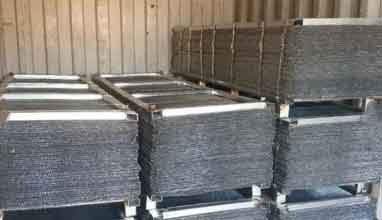
Packaging and international transportation.
A custom decorative pattern may require additional tooling or manufacturing evaluation.
For bulk procurement, buyers should request specification-based quotations rather than comparing only price per sheet.
Expanded Metal Pattern Quotation Checklist
For accurate B2B quotations, buyers should provide the following information.
| Required Information | Example |
|---|---|
| Pattern Type | Standard Diamond / Micro / Decorative |
| Surface Profile | Raised / Flattened |
| Material | Carbon Steel / Aluminum / Stainless Steel |
| Material Grade | Aluminum 3003 / SS304 / SS316 / Other |
| SWD | Short Way of Diamond |
| LWD | Long Way of Diamond |
| SWO / LWO | Clear opening dimensions where required |
| Strand Width | Required width in mm |
| Original Sheet Thickness | Required thickness in mm |
| Panel Dimensions | Length × Width |
| Pattern Orientation | Horizontal / Vertical according to drawing |
| Surface Finish | Galvanized / Powder Coated / Mill Finish |
| Color | RAL or other reference where applicable |
| Quantity | Sheets or total square meters |
| Application | Facade / Industrial / Screening / Construction |
| Destination | Country and delivery port |
| Technical Drawings | PDF / CAD / Reference Photograph |
Providing complete technical information helps suppliers evaluate manufacturing feasibility and prepare comparable quotations.
Frequently Asked Questions About Expanded Metal Patterns
1. What is the most common expanded metal pattern?
The diamond pattern is the most commonly recognized expanded metal design.
It is widely used in industrial, architectural, protective, and construction applications.
Different SWD, LWD, and strand dimensions are available depending on manufacturing capabilities.
2. What is the difference between SWD and SWO?
SWD describes the short-way dimension of the repeating expanded metal design.
SWO refers to the short-way clear opening.
These measurements are not interchangeable.
3. What is the difference between raised and flattened expanded metal?
Raised expanded metal retains the three-dimensional structure formed during expansion.
Flattened expanded metal undergoes additional rolling to create a flatter surface.
4. Are square and hexagonal expanded metal patterns available?
Some specialized manufacturing methods can produce square-like, hexagonal-like, or other decorative patterns.
However, these designs are not universally available through conventional expanded metal production.
Manufacturing feasibility should be confirmed using detailed drawings.
5. What is micro expanded metal?
Micro expanded metal features relatively fine interconnected openings.
It is used in selected screening, ventilation, protective, decorative, and filter-support applications.
6. Do smaller diamond openings make expanded metal stronger?
Not automatically.
Mechanical performance depends on material grade, strand width, original thickness, opening geometry, orientation, and supporting conditions.
7. What pattern is suitable for architectural facades?
Standard diamond, flattened diamond, and appropriate custom decorative patterns may be considered.
The correct choice depends on appearance, shading, ventilation, structural design, and environmental exposure.
8. Which pattern is used for expanded metal lath?
Specialized diamond-pattern expanded metal lath is commonly used in suitable plastering and stucco systems.
The required product must meet the applicable construction specifications.
9. Can expanded metal patterns be powder coated?
Suitable expanded metal products can receive powder coating.
Other finishes may include galvanizing, painting, or anodizing for compatible aluminum materials.
The appropriate finish depends on material and application.
10. Can expanded metal be manufactured with custom opening dimensions?
Custom dimensions may be possible depending on material, tooling, opening geometry, order quantity, and manufacturing feasibility.
Technical drawings help suppliers review custom requirements.
11. What pattern is best for machinery guards?
The suitable pattern depends on the equipment design, required opening size, safety distance, material, and complete guarding system.
No single opening pattern is appropriate for every machine.
12. What information is required for an expanded metal pattern quotation?
Buyers should provide pattern type, material, SWD, LWD, strand width, thickness, panel dimensions, surface finish, quantity, and destination.
For custom projects, dimensioned technical drawings are recommended.
Conclusion: Selecting Expanded Metal Patterns for Your Project
Expanded metal patterns play an important role in determining the appearance and functional characteristics of expanded metal products.
Standard diamond patterns are widely used in construction, industrial, and protective applications. Micro diamond patterns provide smaller openings for selected screening and ventilation requirements.
Raised and flattened expanded metal offer different surface profiles, while specialized decorative patterns provide additional possibilities for architectural projects.
For international buyers, accurate selection depends on more than the visual pattern.
Material grade, SWD, LWD, strand width, original sheet thickness, open area, surface treatment, panel dimensions, and installation requirements should all be considered.
ANPING METAL MESH provides expanded metal product information and supports specification-based enquiries for industrial, construction, and architectural applications.
Request Custom Expanded Metal Patterns
Looking for expanded metal patterns for building facades, industrial machinery guards, construction, decorative panels, or wholesale distribution?
Send us your required material, diamond dimensions, strand width, thickness, panel size, surface finish, quantity, and delivery destination.
For custom decorative patterns, please include technical drawings or reference photographs.
Our team can review the specifications and discuss appropriate product options and manufacturing requirements.
Diamond Expanded Metal | Micro Expanded Mesh | Raised and Flattened Patterns | Decorative Panels | Custom Specifications | B2B Supply
Visit our Expanded Metal Product Center or Contact ANPING METAL MESH to request a quotation.
Need help choosing a metal mesh?
Share your material, dimensions, intended use and required quantity. We can review the details for a quotation.